MiniMax H3 Max Review: Is the Speed Worth It?
A review of MiniMax H3 Max, fal.ai’s speed-optimized post-training of MiniMax H3 — what it’s good at, where it falls short, and who should actually use it.

Verdict: MiniMax H3 Max is the fastest way to get high-quality AI video out of the MiniMax H3 family, and independent benchmarks back that claim up. The tradeoff is real, though — it tops out at 768p, it’s currently limited to text-to-video and image-to-video, and it isn’t the model to reach for if a shot needs 2K resolution or several reference files at once. For fast iteration and mainstream-resolution output, it’s genuinely good. For anything past that, it’s the wrong tool.
What MiniMax H3 Max Actually Is
MiniMax H3 Max isn’t a new model built from scratch — it’s a post-trained version of the open-weight MiniMax H3, developed by fal.ai’s research team specifically to push inference speed without giving up quality. fal introduced substantial new training data during post-training, with a particular focus on prompt adherence and aesthetics, and paired that with inference optimization work the team has spent years on for diffusion models generally.
The pitch is straightforward: most video models treat speed and quality as a tradeoff. H3 Max is fal’s attempt to move both at once, rather than sacrificing one for the other.
The Benchmarks
This is where H3 Max’s claims hold up better than most model announcements. Two independent evaluation sources back the speed-and-quality pitch:
Design Arena scores H3 Max at an Elo of 1,341 on its image-to-video board — ahead of the base MiniMax H3 model it was post-trained from, and every other model listed at the time of scoring.
Artificial Analysis ranks H3 Max first among video models evaluated with audio, at an Elo of 1,201 (95% confidence interval of ±11 over 2,177 samples).
fal reports its own human preference evaluations placing H3 Max #1 across overall quality, prompt understanding, and aesthetics against leading video models — while generating a 5-second clip in under 3 seconds, roughly 35x the throughput of the official MiniMax H3 endpoint, and about 15x faster than anything else in its quality range.
That last figure is the one worth sitting with. A 35x throughput gain over the base model it’s derived from isn’t a marginal optimization — it changes what kind of workflow the model actually supports. Most video models improve incrementally release over release; a jump this size usually means the team changed what they were optimizing for, not just how well they optimized it. fal’s own framing backs that up: they describe evaluating quality, prompt understanding, and aesthetics independently during post-training rather than optimizing toward a single blended score, which is part of why the speed gain doesn’t come with the usual quality asterisk attached to “fast” model variants.
It’s worth being specific about what these benchmark numbers do and don’t tell you. An Elo score is relative — it says H3 Max beat other models in head-to-head preference comparisons, not that it hit some absolute quality bar. Design Arena’s 1,341 and Artificial Analysis’s 1,201 are both meaningful within their respective leaderboards, but they’re not directly comparable to each other since the evaluation methodologies differ. What they agree on is the direction: across two independent evaluation setups, H3 Max ranks at or near the top of its category. That kind of agreement across different testing methodologies is a stronger signal than either number alone.

What It’s Good At
Iteration speed. This is the entire point of the model, and it delivers. Sub-3-second generation for a short clip means you can treat a prompt as a hypothesis to test rather than a commitment to get right on the first try.
Prompt adherence. fal specifically tuned post-training toward stronger prompt adherence, and it shows in independent rankings — H3 Max isn’t winning purely on speed while sacrificing accuracy to the prompt.
Native audio, without a separate pass. Like base H3, audio generates jointly with the video rather than as an added step, so a quick draft still comes back with sound rather than a silent clip you’d need to score separately.
Image-to-video for quick concept tests. Upload a starting frame and get a fast read on whether an idea works before committing more time to it elsewhere.
Lower cost of being wrong. This is less a feature than a consequence of the speed, but it’s worth naming directly: when a generation takes seconds instead of minutes, a prompt that doesn’t work costs you almost nothing. That changes the psychology of testing — you’re more likely to try the weird version of a prompt, the risky camera angle, the unconventional pacing, because the downside of a bad result is a few seconds, not a stalled workflow.
Where It Falls Short
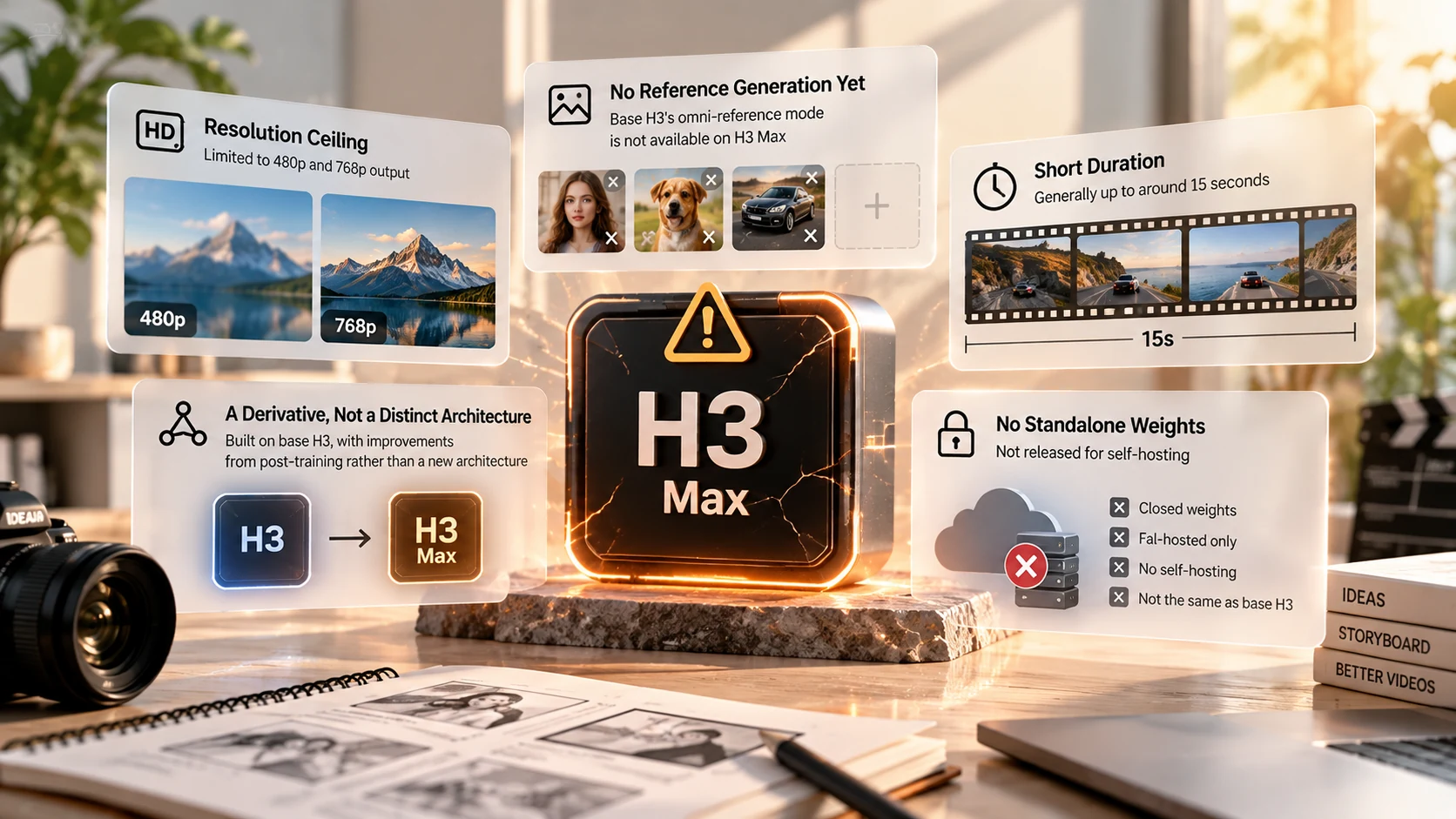
Resolution ceiling. H3 Max targets mainstream 480p and 768p output — a real step down from base H3’s 2K. If the deliverable needs to hold up at a large size, H3 Max isn’t the model for that job.
No reference generation yet. Base MiniMax H3’s omni-reference mode — up to 9 images, 3 video clips, and 3 audio clips in one task — isn’t available on H3 Max. It’s listed as coming soon, but as of now, H3 Max covers text-to-video and image-to-video only.
Duration stays short. H3 Max inherits the short-clip range of the H3 family, generally up to around 15 seconds. It’s not a fit for a longer narrative arc.
It’s a derivative, not a distinct architecture. Everything H3 Max does well, it does well because of what it inherited from base H3. That’s not a criticism of the execution, but it does mean H3 Max’s ceiling is defined by decisions made in the original model, not by fal’s post-training alone.
No standalone weights. Base MiniMax H3 is released under a community license that permits self-hosting for qualifying organizations. H3 Max is a fal-hosted post-training of those weights — running it outside of fal’s infrastructure (or a platform like ZMS AI that connects to it) isn’t the same kind of option base H3’s open release provides.
What the Speed Actually Changes About Your Workflow
It’s easy to read “faster generation” as a convenience and move on, but it’s worth spelling out what it actually does to how you work, because the effect is bigger than a shorter wait.
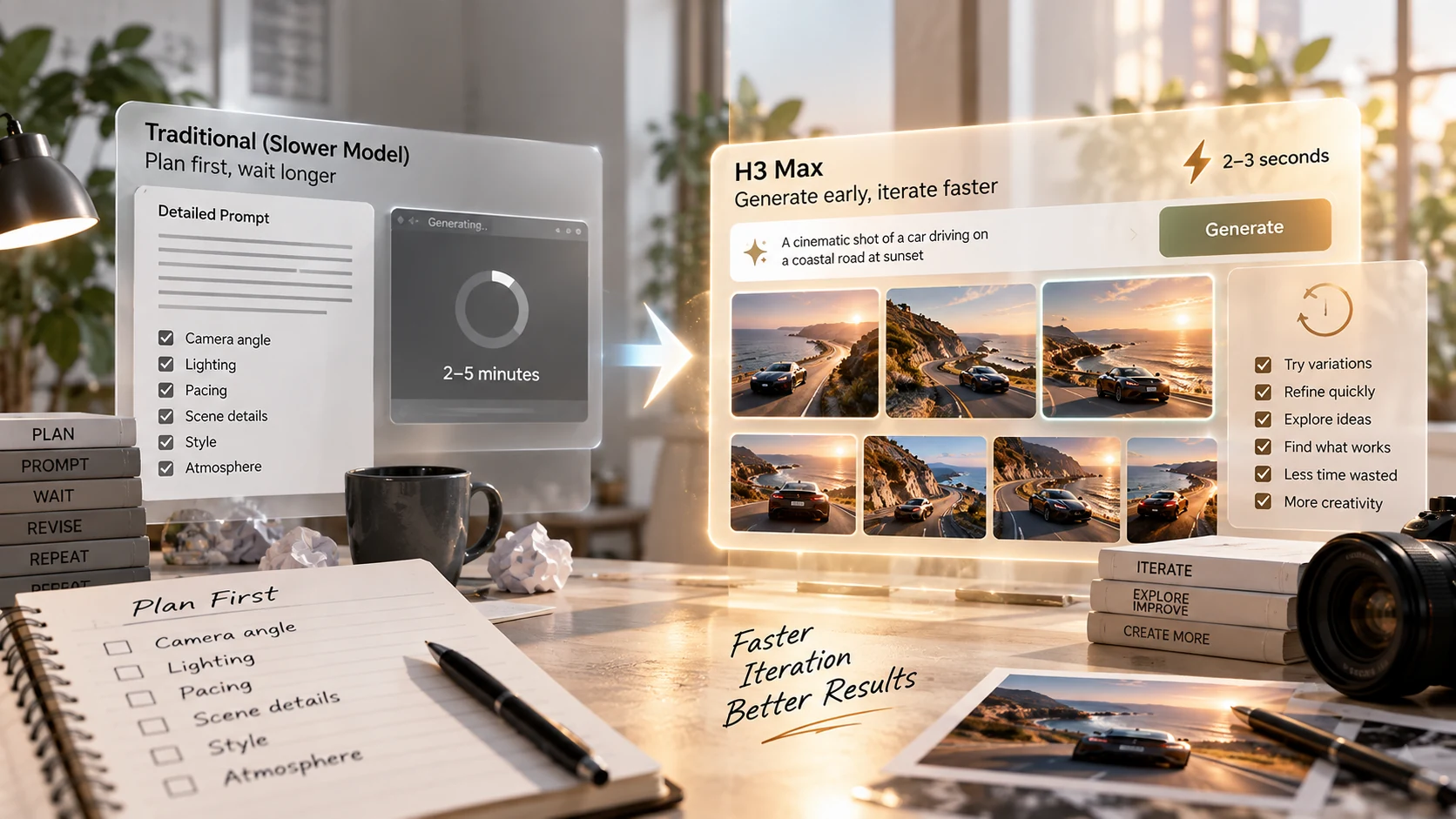
With a slow model, the rational move is to spend most of your time on the prompt before you ever click generate — think through the camera angle, the lighting, the pacing, because each attempt is expensive in time. That front-loaded planning style is a reasonable adaptation to slow feedback loops, but it also means you’re relying entirely on your own judgment to predict what will work, before you have any evidence.
With H3 Max, that math flips. A rough prompt costs seconds to test, so the rational move becomes generating early and often, and letting the results themselves guide the next revision rather than trying to anticipate everything up front. This is closer to how iterative design tools work in other domains — you don’t sketch a UI perfectly before testing it with users, you get something in front of people fast and adjust. H3 Max makes that same loop viable for video generation in a way that slower models don’t.
The practical upshot: if your current workflow with another model involves long prompt-writing sessions before a single generation, that habit is worth rethinking specifically for H3 Max. The model rewards a different rhythm — shorter prompts, more attempts, faster convergence on what actually works.
H3 Max vs Base MiniMax H3, in Short
MiniMax H3 Max | MiniMax H3 | |
|---|---|---|
Resolution | 480p / 768p | Up to 2K |
Input modes | Text-to-video, image-to-video | Text-to-video, image-to-video, omni-reference |
Speed | Significantly faster (fal-optimized) | Standard |
Reference files | Not yet supported | Up to 9 images, 3 video, 3 audio |
The short version: H3 Max trades reference capability and resolution ceiling for speed. If your task needs either of those, base H3 is the model, not H3 Max.
Where H3 Max Fits Against Other Fast-Iteration Options
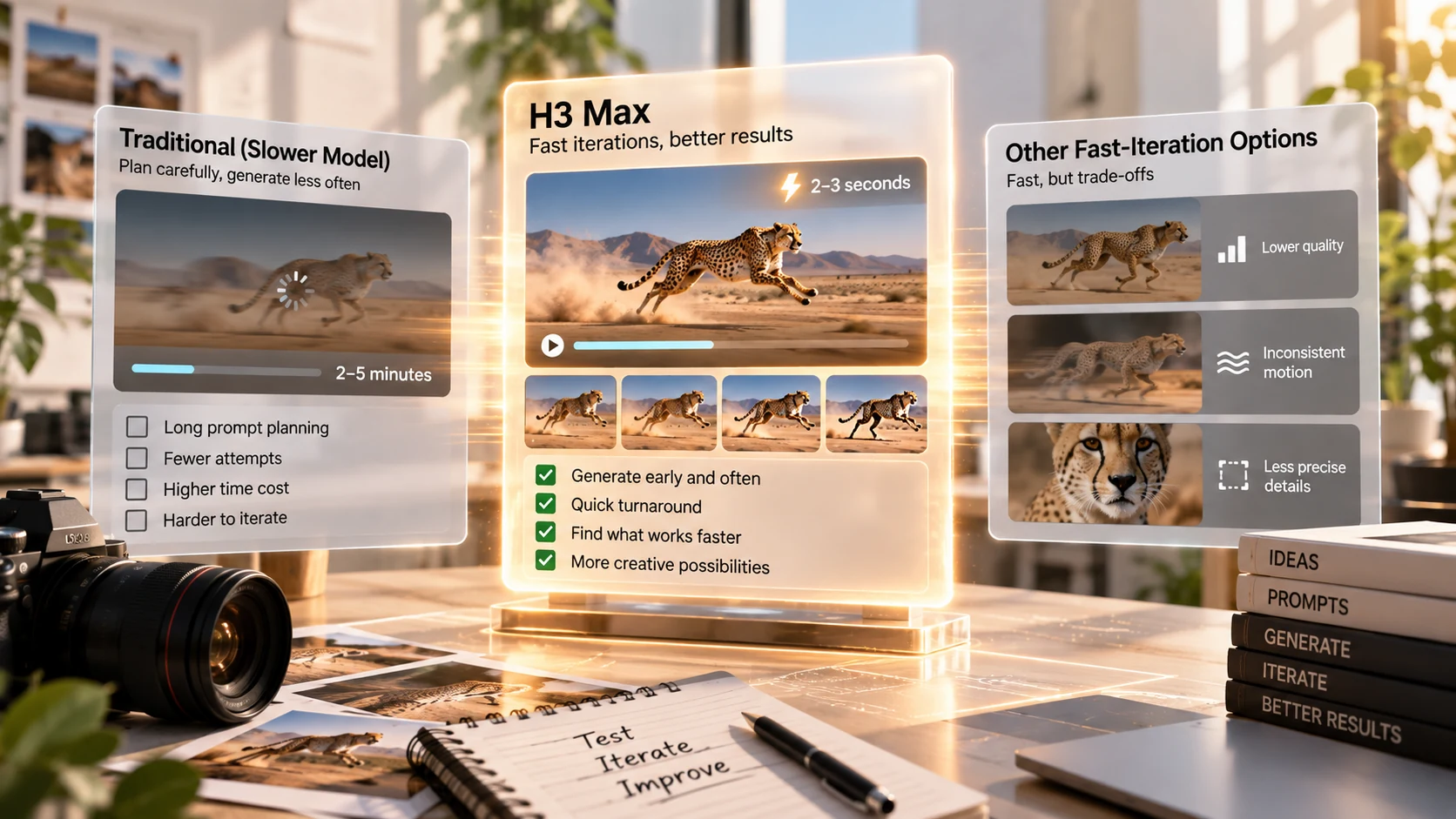
H3 Max isn’t the only model on the market built around rapid generation, and it’s worth being clear about what specifically sets it apart rather than treating “fast” as a single undifferentiated category. Plenty of models offer quick turnaround by simply reducing resolution or step count, which usually shows up as a visible quality drop — smeared detail, inconsistent motion, prompts that get roughly right rather than precisely right.
What the independent benchmarks suggest is that H3 Max isn’t taking that shortcut. Ranking first on Artificial Analysis’s audio-inclusive leaderboard and ahead of its own base model on Design Arena’s image-to-video board means the speed gain isn’t purchased with a proportional quality loss — which is the harder engineering problem, and the one most “fast” model variants don’t actually solve. That’s the real differentiator: not that H3 Max is fast, but that it’s fast without the usual asterisk.
Who Should Actually Use H3 Max
Use it if:
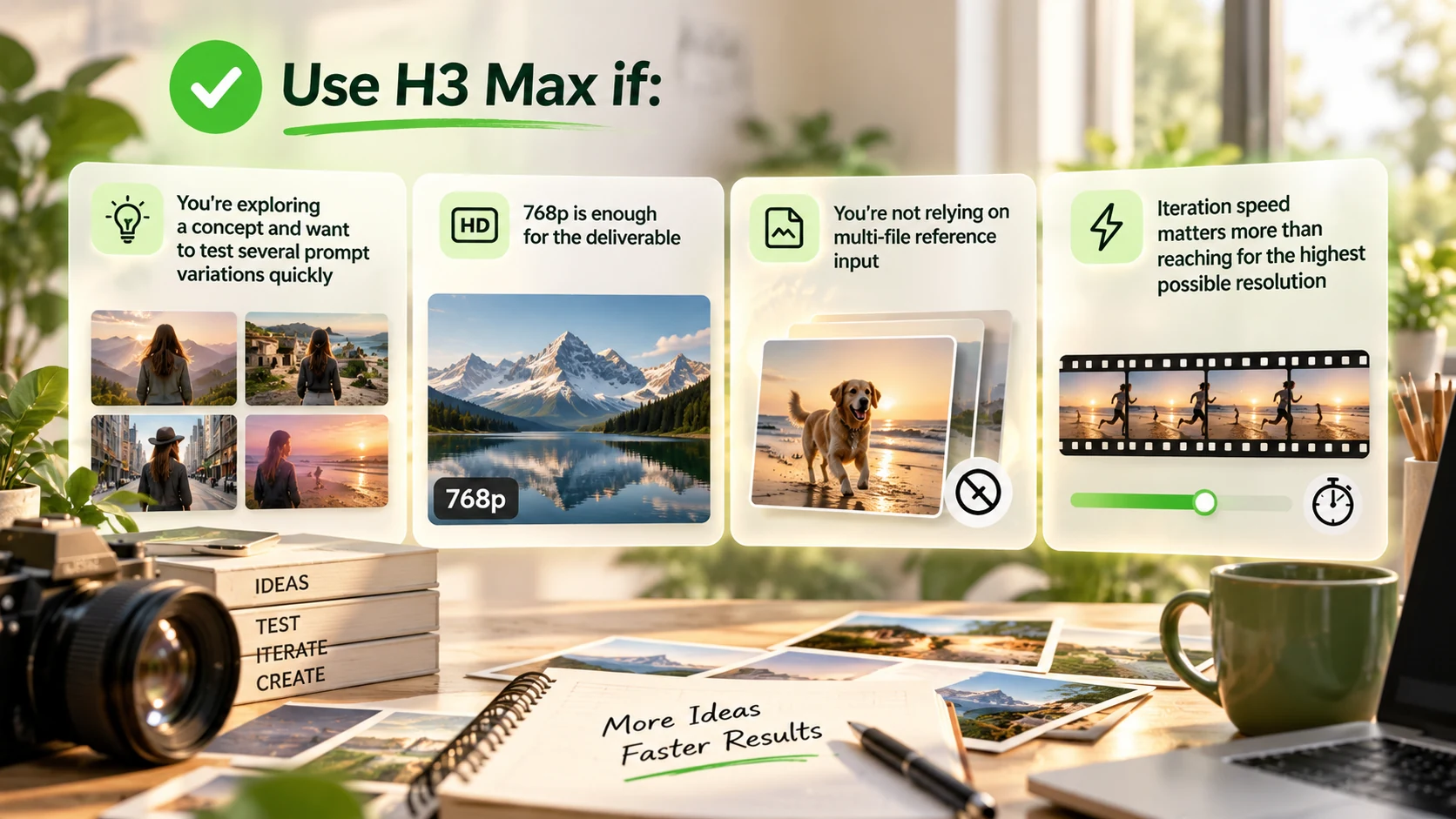
You’re exploring a concept and want to test several prompt variations quickly
768p is enough for the deliverable
You’re not relying on multi-file reference input
Iteration speed matters more than reaching for the highest possible resolution
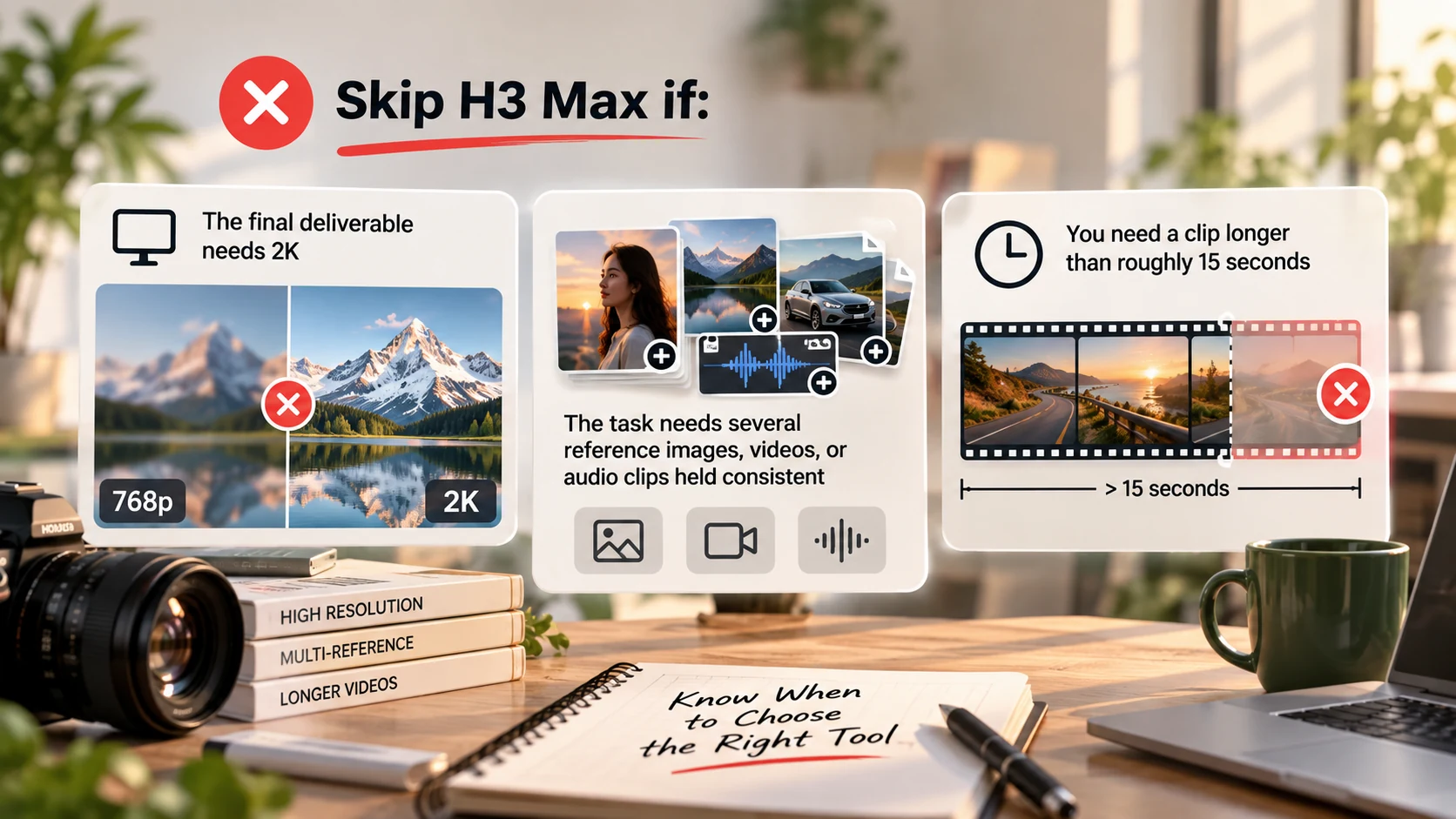
Skip it if:
The final deliverable needs 2K
The task needs several reference images, videos, or audio clips held consistent
You need a clip longer than roughly 15 seconds — no model in the H3 family reaches that, so this isn’t specific to H3 Max, but worth flagging regardless
A practical middle path: if you’re not sure which category your project falls into, start with H3 Max regardless. Its speed makes it cheap to find out whether 768p and two-mode input are enough for the concept before you commit to base H3’s slower, higher-ceiling workflow. Worst case, you’ve spent a few seconds per attempt confirming you need to switch models — which is still faster than starting cold on a slower model and discovering the same thing after a longer wait.
The Bottom Line
MiniMax H3 Max does what it says it does: it’s meaningfully faster than base MiniMax H3, and the independent benchmarks suggest that speed didn’t come at the cost of quality or prompt adherence, which is the harder claim to actually deliver on. The honest limitation isn’t the execution — it’s the scope. H3 Max is built for fast iteration at mainstream resolution, not for every video generation task. Know which category your shot falls into before picking it.
FAQ
Is MiniMax H3 Max better than MiniMax H3? Not universally — it’s faster and performs well on independent benchmarks, but it caps at 768p and doesn’t yet support reference generation, both of which base H3 offers.
How much faster is H3 Max than base H3? fal reports roughly 35x the throughput of the official MiniMax H3 endpoint for a short clip, and about 15x faster than other models in a comparable quality range.
Does H3 Max support reference images? Not yet. It currently supports text-to-video and image-to-video only; reference generation is listed as coming soon.
What’s the highest resolution H3 Max reaches? 768p. For 2K, use base MiniMax H3 instead.
Who developed H3 Max? It was post-trained by fal.ai on top of the open-weight MiniMax H3 model, released jointly by MiniMax and fal.ai.
Can I self-host H3 Max the way I can with base MiniMax H3? Not in the same way. Base H3 is released under a community license that permits self-hosting for qualifying organizations. H3 Max is a fal-hosted post-training of those weights, so it’s accessed through fal’s infrastructure or platforms connected to it, like ZMS AI, rather than run independently.
Do the benchmark scores mean H3 Max is objectively the best video model available? Not exactly — Elo scores reflect relative performance within a specific leaderboard’s head-to-head comparisons, not an absolute quality measurement. What’s notable is that two independently run evaluations (Design Arena and Artificial Analysis) both rank H3 Max at or near the top of its category, which is a stronger signal than either score alone would be.
Try MiniMax H3 Max
MiniMax H3 Max is available in the AI Video Generator on ZMS AI.